Creative 提示词分类

Creative AI 图像提示词

浏览 Creative 相关示例与可复用的 AI 图像提示词方向,用于规划主体、构图、灯光、色彩、材质和视觉风格。

该合集依据 PromptPlum 的 Creative 分类整理。可将这些参考方向改写为适合自身主体、尺寸与视觉目标的提示词。

视觉参考组
creative
内容规模
3 个公开提示词
视觉参考组04 / REF
Creative AI 图像提示词 reference 101
Creative AI 图像提示词 reference 202
Creative AI 图像提示词 reference 303
Creative AI 图像提示词 reference 404
VEYVIA / CREATIVE已整理
提示词画廊

选择一个最接近的画面。

打开任意样片查看完整提示词,或直接带着参考图与画面比例进入生成器。

3 个公开提示词
Creative AI 图像提示词 prompt 101
creativegraphic-designtypography-art

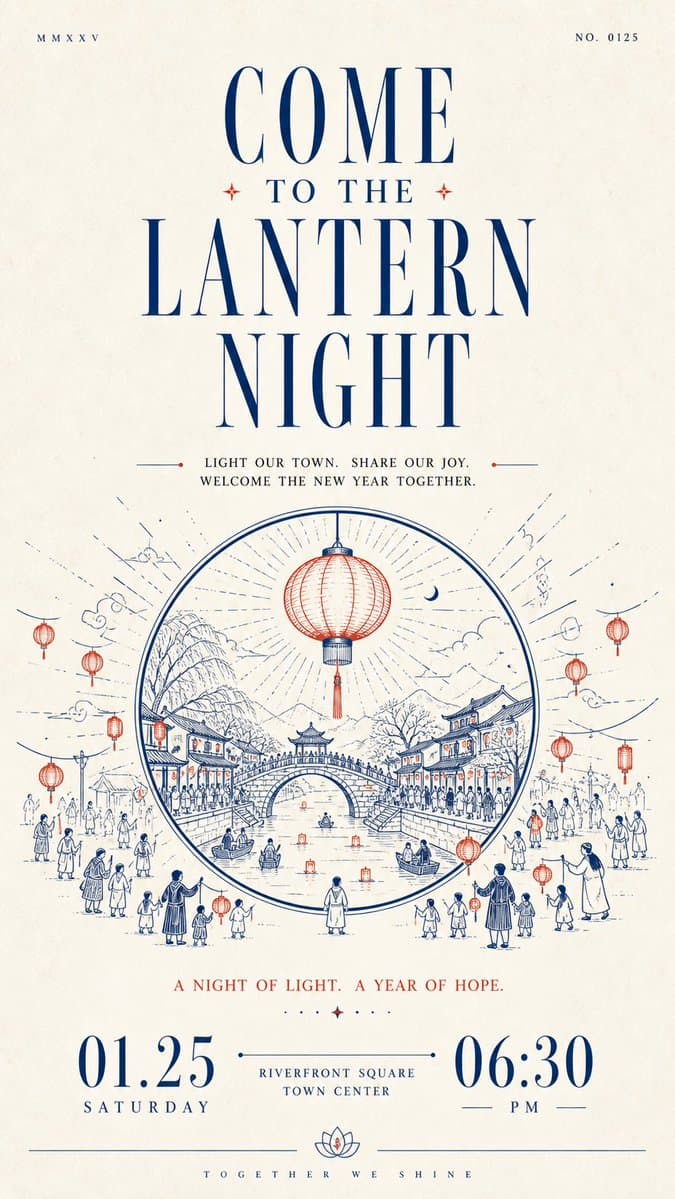
Build a restrained, solemn paper-based informational design with human warmth around any chosen thematic subject: let large areas of bright white space first establish quiet order, then let a striking headline, line-drawn narrative, and bottom numerals carry the reading onward in sequence. Organize clearly differentiated modules along a single main reading axis: near the top, place one extremely small, thin, widely letterspaced auxiliary text or numbering group on each side, separated by remote spacing to create slight asymmetry; beneath them, set an oversized, high-contrast Latin serif headline extending horizontally, with strong contrast between fine hairlines and thick stems, elongated letterforms, sharp terminals, and the same accent ink as the core illustration; then add a centered group of short Chinese phrases on the theme, built on a slender Songti skeleton with generous line spacing and breathing room between characters, so the dark text block both carries the headline and builds momentum toward the illustration. Distill the thematic subject's core image and its relationship to the environment into a monochrome printmaking-style line drawing rather than reproducing fixed objects: build outward spatial movement from the center with clear outer contours, continuous arcs, layered paths, and a few flat fills; keep foreground lines longer and more open, make the middle forms the heaviest, and finish the distance with fine short strokes; alternate dense detail with large expanses of empty paper, keep the contours legible, allow slight hand-drawn variation in line weight, and preserve the soft, blunted edges created by ink absorption at corners of a printed mark, so the image has a monumental stability without feeling heavy. Place the most important short notice phrase below the illustration, then anchor the bottom visual weight with a group of oversized, high-contrast numerals or equally scaled key information, spreading the left and right information apart and connecting the center with an ultra-fine horizontal line and small text, so the extreme scale differences create the ceremony of a formal announcement; finish with a hairline rule running across the bottom edge, lifted at its center by a small symmetrical emblem derived from the theme, and set a micro Latin wordmark beneath it with extremely wide letterspacing for a quiet, precise ending. Derive the color adaptively from the theme: the theme's meaning decides the specific hue and warm/cool character of the accent, which should stay medium-high in saturation, clean, and slightly pigment-like, occupying roughly one-tenth to two-tenths of the image and concentrated in the large headline, core line drawing, and bottom fine lines; give the background a near-white, low-saturation paper color that harmonizes with the accent, lets it dominate the composition, and keeps it high in lightness; use a near-black with the same warm/cool tendency for body text and numerals, limiting it to the typographic skeleton and local contrast. Keep an asymmetric area contrast rather than an even color balance: the more vivid the accent color, the more restrained the paper and the fewer, more precise the dark areas. Render the surface as fine uncoated paper fiber with slight uniform grain and a soft scanned feel; keep the texture mainly on the blank paper and visible through thin layers of ink, allow only tiny tonal variation in solid areas, and avoid heavy stains, strong creases, gloss, dimensional shadows, or decorative gradients; the whole design should remain bright, airy, and slightly edged by the paper's ink absorption, preserving the order among white space, line drawing, typographic scale jumps, and bottom closure, while preventing the illustration from expanding and squeezing the information or the text from averaging out and losing rhythm.

Creative AI 图像提示词 prompt 202
twittermixed-media-artdigital-art

I modified my Pele prompt, so it now works for any famous person. Do this for beethoven: <instruction> 1. Inference Engine Input A is a Globally Recognized Figure (e.g., Pelé, Muhammad Ali, Frida Kahlo, Winston Churchill). Deconstruct the figure's legacy into 4 Collage Assets : The Anchor (The Portrait): Identify a recognizable, smiling, front-facing portrait of the individual. The Terrain (The Map): Identify the outline of their home country or most significant region. (e.g., Pelé -> Brazil. Churchill -> United Kingdom. Kahlo -> Mexico). The Colors (The Theme): Identify the dominant colors associated with their nation or profession. (e.g., Pelé -> Yellow, Green, Blue. Kahlo -> Vibrant primary colors and earth tones). The Ephemera (The Clutter): Identify specific historical objects related to their career. (e.g., Pelé -> Tiny World Cup trophies, old match tickets, cheering fans. Churchill -> Telegraphs, medals, cigars). 2. Container (The Collage Board): Goal: A "Mixed-Media Mosaic" Flat Lay. The Base: A square piece of heavy cardboard, corkboard, or rough wood lying flat. The Technique: The entire image is a densely packed physical collage made of torn paper, vintage photographs, ticket stubs, and small 3D objects glued to the board. 3. The Mosaic Portrait The Construction: The portrait (Input A) dominates the center of the frame. The Illusion: The face is NOT a single painted image. It is a "Photo Mosaic" created by hundreds of tiny, distinct, overlapping rectangular and torn pieces of paper (e.g., tiny faces, skin-toned paper scraps, historical photos). Detail: The viewer must be able to see the individual paper edges and overlapping corners making up the eyes, smile, and hair. 4. The Background The Map: Behind the portrait, the outline of the "Terrain" (Step 1) is constructed using larger, torn pieces of solid-colored paper matching the "Theme" colors (e.g., Green and Yellow paper forming Brazil). The Crowd: The bottom corners and edges are filled with cut-out photos of cheering crowds, teammates, or relevant historical figures reacting to the main subject. The Detritus: The remaining empty space is jammed with the "Ephemera" (vintage tickets, logos, handwritten notes, small 3D pins/trophies glued to the surface). 5. Lighting & Atmosphere: Lighting: Flat Studio Copy-Stand Lighting. Even, bright illumination from above that casts very tiny, sharp drop shadows underneath the curled edges of the torn paper and 3D objects, emphasizing the physical, layered texture of the collage. Texture: High fidelity. The grain of the paper, the glossy sheen of the tiny photos, and the glue marks should be visible. Output: ONE image, 1:1 Aspect Ratio, Macro Photography of Mixed Media Art, "Scrapbook Mosaic" aesthetic, Horror Vacui (no empty space). </instruction>

Creative AI 图像提示词 prompt 303
twitterconceptual-artabstract-splash-art

Grok Imagine Image Prompt Share. Food Galaxy: A cosmic/space scene where various Indian street foods are floating in deep space as if they are planets, moons, and celestial objects in a delicious galaxy. 𝗧𝗛𝗘 𝗙𝗢𝗢𝗗 𝗦𝗢𝗟𝗔𝗥 𝗦𝗬𝗦𝗧𝗘𝗠: - CENTER (Sun): A massive round tandoori roti, glowing from within like a star, with charred spots resembling sunspots, radiating warm golden light outward - PLANET 1 (closest): A perfect round golgappa/pani puri — crispy shell glistening, filled with spiced water visible through the opening. Tiny orbit ring of sev and chutney droplets. - PLANET 2: A round vada (medu vada) as a donut-shaped planet with a ring system made of coconut chutney - PLANET 3: A plate of round gulab jamuns as a cluster of sweet brown planets with syrup nebula around them - ASTEROID BELT: Dozens of floating samosas, pakoras, and bhel pieces scattered in a ring - PLANET 4 (gas giant): A huge round dahi vada — white yogurt surface like a cloudy gas giant, with tempering (tadka) marks resembling Jupiter's storms - COMET: A kebab skewer streaking across the scene with a trail of spice smoke and sparks - MOON: A round idli orbiting the dahi vada planet - NEBULA: A colorful cloud of turmeric (yellow), chili (red), and coriander (green) powders mixing in space, forming a stunning spice nebula 𝗕𝗔𝗖𝗞𝗚𝗥𝗢𝗨𝗡𝗗:- Deep space black with thousands of tiny stars (mustard seeds and cumin seeds floating as stars) - Distant galaxies made of swirling masala powder - The Milky Way visible but made of a stream of white lassi/buttermilk 𝗟𝗜𝗚𝗛𝗧𝗜𝗡𝗚:- The tandoori roti "sun" provides warm orange light illuminating nearby foods - Each food item has its own subtle glow — the hot items emit warm light, the cold items (lassi, curd) emit cool blue light - Dramatic space lighting: stark bright highlights, deep black shadows, no atmosphere 𝗦𝗧𝗬𝗟𝗘: Photorealistic food photography meets NASA space photography. Every food item is rendered with appetite-triggering detail — crispy textures, steam, glistening oil, fresh garnishes — but floating in actual outer space with real stars and cosmic phenomena. This surreal combination is the kind of image people share saying "this is the most Indian thing I've ever seen." 8K resolution. No Text labels Anywhere. Compare this with Nano Banana 2 output:

从参考到成图

三步开始,不必从空白画布想起。

  1. 01

    选择参考

    先按构图、色彩和用途选择最接近目标的样片。

  2. 02

    调整细节

    进入生成器后修改主题、文案、风格和画面比例。

  3. 03

    生成成图

    保留预填参考图,一键生成,再针对结果继续微调。

没有完全合适的样片?

从空白提示词开始,自由定义主题、构图、文字和画面比例。

从零创作
使用说明

让第一次生成更接近成品。

01

Creative 提示词适合做什么

Creative 提示词用于围绕特定风格、主体、媒介或摄影用途组织视觉创意,公开示例会随内容发布持续更新。

02

怎样写好 Creative 提示词

先写明主要主体,再补充构图、环境、灯光、配色、材质、镜头或渲染方式、画面比例与最终用途。

03

如何继续优化生成结果

删除互相冲突的风格要求,保持一个清晰的视觉方向,并在发布前检查结构、文字、标志、透视和分类相关细节。

常见问题

开始前,你可能还想知道。

Creative AI 图像提示词是什么?

这是归入 Creative 分类的可复用视觉简报,可根据不同主体、参考图、构图和输出尺寸进行修改。

Creative 示例是如何加入这个合集的?

当已发布提示词的主体、风格或用途与 Creative 分类匹配时,它们会被归入这个合集。

这些 Creative 提示词可以修改吗?

可以。替换主体和场景后,再根据项目调整灯光、配色、材质、镜头或渲染方式、画面比例和细节程度。