geometric-designmonochrome-artposter-design
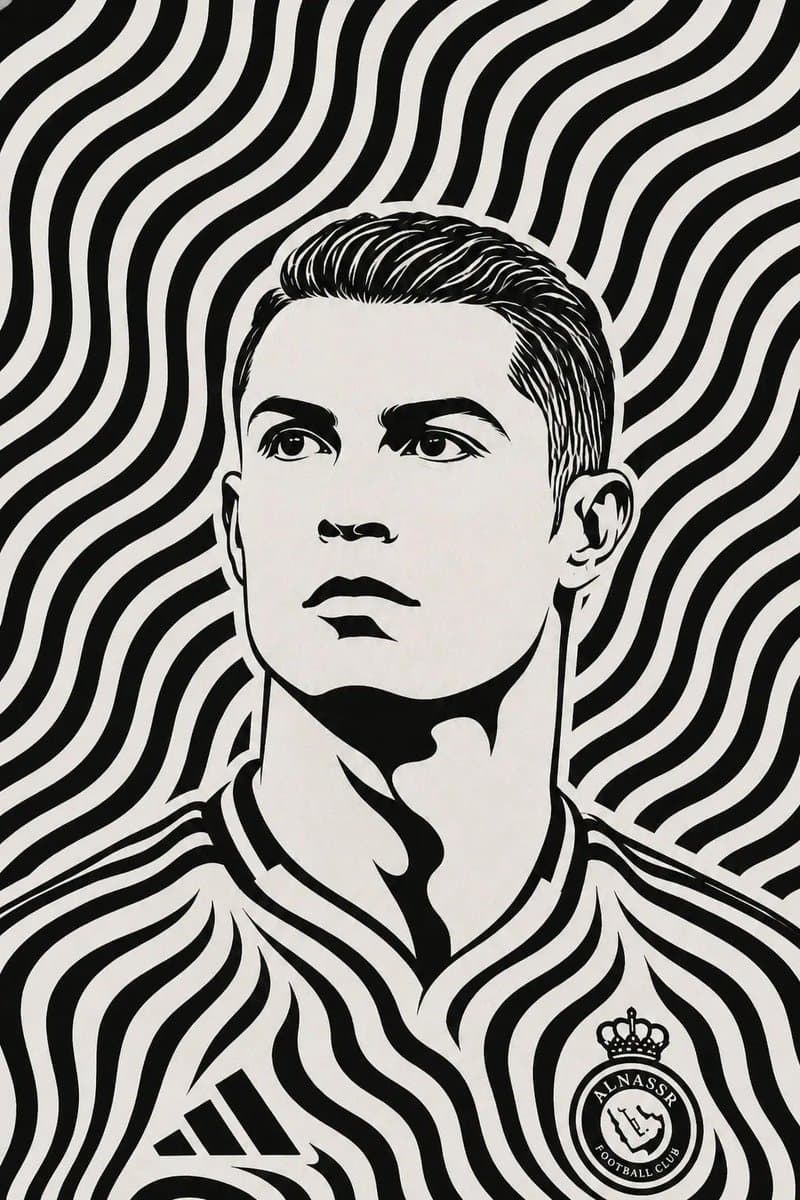
A highly detailed black-and-white optical illusion portrait illustration of a confident athletic man, created entirely from flowing wavy stripes. The artwork uses alternating black and white curved lines that seamlessly form both the subject and the background, producing a mesmerizing Op Art effect. High contrast monochrome design, clean vector style, ultra-sharp edges, minimalistic yet intricate linework, poster-quality graphic artwork, centered composition, vertical portrait orientation (4:6).
Face Structure
Face and Head:
Symmetrical masculine face
Strong jawline and defined chin
Straight nose with simplified graphic shading
High cheekbones
Smooth skin represented by negative white space
No realistic skin texture
Minimalist vector facial construction
Clean black shadow shapes defining contours
Eyes:
Large expressive eyes
Looking slightly upward and to the side
Sharp eyebrows with bold black fills
Detailed iris and pupil
Determined and focused expression
Mouth:
Closed lips
Neutral confident expression
Minimal black shapes defining upper and lower lips
Hair
Hair Style:
Short athletic haircut
Neatly combed back
Dense flowing line details
Hair strands formed by curved white highlights over black mass
Clean graphic texture
Sharp silhouette
Neck and Shadows
Neck Design:
Strong muscular neck
Deep black shadow regions
Abstract organic shadow shapes
Smooth transitions between positive and negative space
High contrast graphic treatment
Clothing
Football Jersey:
Modern football/soccer jersey
Constructed from the same flowing wavy stripe pattern
Stripes integrated seamlessly with the portrait
Black-and-white monochrome only
Stylized sportswear appearance
Logo Area:
Circular football club crest
Highly simplified vector rendering
Sharp clean outlines
Monochrome graphic style
Optical Illusion Pattern
Primary Pattern:
Continuous vertical wavy lines
Smooth sinusoidal curves
Uniform line thickness
Alternating black and white bands
Pattern flows through face, hair, neck, clothing, and background
No disconnected elements
Op Art Effect:
Inspired by classic optical illusion posters
Visual vibration effect
Seamless integration of figure and background
Hypnotic wave motion
Elegant geometric rhythm
Composition
Camera and Layout:
Chest-up portrait
Subject centered
Straight portrait framing
Slight upward gaze
Balanced composition
Full vertical canvas
4:6 aspect ratio
Lighting
Lighting Style:
High contrast monochrome lighting
No grayscale
Pure black and pure white
Graphic shadow design
Posterized lighting
Vector illustration aesthetics
Artistic Style
Style Keywords:
Optical illusion art
Op Art
Victor Vasarely inspired
Contemporary vector poster
Graphic design masterpiece
Monochrome portrait
Wavy line illustration
Minimalist black and white
Ultra-clean vector artwork
Precision linework
Gallery-quality poster design
High-detail stripe composition
Modern editorial illustration
Negative Prompt
Negative Prompt:
color, colorful, grayscale, gray tones, realistic skin texture, photorealistic rendering, painterly brush strokes, watercolor, oil painting, low contrast, blurry, low resolution, pixelated, distorted face, asymmetrical eyes, extra eyes, extra ears, extra nose, extra mouth, deformed anatomy, bad proportions, messy lines, broken stripes, disconnected pattern, random shapes, cluttered background, text, watermark, signature, logo overlay, frame, border, noise, grain, artifacts, 3D render, CGI, cartoon, anime, comic style, oversaturated, soft focus, low detail, duplicate features, mutated hands, cropped head, tilted composition, uneven line thickness, inconsistent optical illusion pattern
Aspect Ratio: --ar 4:6
Quality Keywords: ultra detailed, crisp vector lines, optical illusion masterpiece, perfect symmetry, seamless stripe integration, high contrast black and white, clean negative space, professional poster design, ultra sharp edges, premium op art illustration
 01
01